from scipy.optimize import root

def manningC(d, args):
    Q, w,h,sSlopeL,sSlopeR,nMann,lSlope = args
    #left side slope can be different from right side slope
    area = ((((d*sSlopeL)+(d*sSlopeR)+w)+w)/2)*d
    # wet perimeter
    wPer = w+(d*(sSlopeL*sSlopeL+1)**0.5)+(d*(sSlopeR*sSlopeR+1)**0.5)
    #Hydraulic Radius
    hR = area/ wPer
    # following formula must be zero
    # manipulation of Manning's formula
    mannR = (Q*nMann/lSlope**0.5)-(area*hR**(2.0/3.0))
    return mannR

###### MAIN CODE
# the following are input data to our open channel manning calculation
# flow, width, height, left side slope, right side slope,
# Manning coefficient, longitudinal slope
args0 = [2.5,2,.5,1.0,1.0,.015,.005]
initD = .00001  # initial water depth value

# then we call the root scipy function to the manningC
sol =root(manningC,initD, args=(args0,))
# print the root found
print(sol.x)
Showing posts with label manning's formula. Show all posts
Showing posts with label manning's formula. Show all posts
Wednesday, May 2, 2018
Solve Manning's Equation with Python Scipy library

Wednesday, July 19, 2017
Solving Manning's equation for channels with Python
Manning's equation is a very common formula used in hydraulic engineering. It is an empirical formula that estimates the average velocity of open channel flow, based on a roughness coefficient.
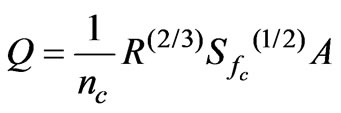
The problem of solving Manning's formula is that it is an implicit formula - the water depth variable (independent variable) is inside R (Hydraulic Radius) and A (flow area) - becoming dificult to isolate the independent variable.
A common approach for solving this equation is to use numerical methods, as the Newton-Raphson method.
In this case, we try different water depths until the function

An implementation for the resolution of the above, for open channels and using the Newton-Raphson approximation, is shown below.
If you found this code of this explanation useful, please let me know.
def manningC(lam, args):
    Q,base,alt,talE,talD,nMann,decl = args
    area = ((((lam*talE)+(lam*talD)+base)+base)/2)*lam
    perM = base+(lam*(talE*talE+1)**0.5)+(lam*(talD*talD+1)**0.5)
    raio = area/ perM
    mannR = (Q*nMann/decl**0.5)-(area*raio**(2.0/3.0))
    return mannR

def solve(f, x0, h, args):
    lastX = x0
    nextX = lastX + 10* h  # "different than lastX so loop starts OK
    while (abs(lastX - nextX) > h):  # this is how you terminate the loop - note use of abs()
        newY = f(nextX,args)  # just for debug... see what happens
        # print out progress... again just debug
        print lastX," -> f(", nextX, ") = ", newY
        lastX = nextX
        nextX = lastX - newY / derivative(f, lastX, h, args)  # update estimate using N-R
    return nextX

def derivative(f, x, h, args):
    return (f(x+h,args) - f(x-h,args)) / (2.0*h)

if __name__=='__main__':
    # arguments in this case are - flow, bottom width, height,
    # Left side slope, rigth side slope, manning, longitudinal slope
    args0 = [2.5,1,.5,1.0,1.0,.015,.005]
    initD = .01
    # call the solver with a precision of 0.001
    xFound = solve(manningC, initD, 0.001, args0)
    print 'Solution Found - Water depth = %.3f' %xFound
Friday, July 29, 2016
Solving Manning's equation with Python
Manning's equation is a very common formula used in hydraulic engineering. It is an empirical formula that estimates the average velocity of open channel flow, based on a roughness coefficient.

The problem of solving Manning's formula is that it is an implicit formula, for the water depth variable, that defines the R (Hydraulic Radius).
A common approach for solving this equation is using numerical methods, as the Newton-Raphson method. An implementation for the resolution of the Manning Formula for pipes, by the Newton-Raphson approximation, is shown below.
The problem of solving Manning's formula is that it is an implicit formula, for the water depth variable, that defines the R (Hydraulic Radius).
A common approach for solving this equation is using numerical methods, as the Newton-Raphson method. An implementation for the resolution of the Manning Formula for pipes, by the Newton-Raphson approximation, is shown below.
def manningTub(depth, args):
    Q = args[0]
    diamMM = args[1]
    nMann = args[2]
    slope = args[3]
    diamM = diamMM / 1000.0
    angle = 2*acos(1-2*depth/diamM)
    area = diamM*diamM/8.0*(angle-sin(angle))
    radius = diamM/4*(1-sin(angle)/angle)
    mannR = (Q*nMann/slope**0.5)-(area*radius**(2.0/3.0))
    return mannR

def solve(f, x0, h, args):
    lastX = x0
    nextX = lastX + 10* h  # "different than lastX so loop starts OK
    while (abs(lastX - nextX) > h):  # this is how you terminate the loop - note use of abs()
        newY = f(nextX,args)  # just for debug... see what happens
        print "f(", nextX, ") = ", newY     # print out progress... again just debug
        lastX = nextX
        nextX = lastX - newY / derivative(f, lastX, h, args)  # update estimate using N-R
    return nextX

def derivative(f, x, h, args):
      return (f(x+h,args) - f(x-h,args)) / (2.0*h)  # might want to return a small non-zero if ==0

#### EXAMPLE CALL

xFound = solve(manningTub, initDepth, 0.001, [flowRate,diam,nMann,enSlope])    # call the solver
Subscribe to:
Posts (Atom)